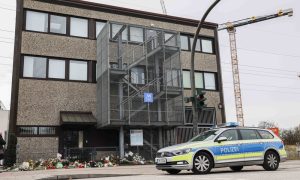
Early on the morning of February 23, 2026, a disturbing violent incident unfolded at the busy central station of Würzburg, a city in southern Germany, drawing alarm and swift response from police, passers-by and authorities. A man armed with a knife approached a small booth where members of the Jehovah’s Witnesses were peacefully engaging with the public. Without apparent warning, he launched an attack that left three men — aged 68, 55 and 51 — shaken and injured in the ensuing struggle. Although none suffered stab wounds or life-threatening injuries, the chaotic scene was serious enough for police to treat the incident as an attempted murder, according to officials.
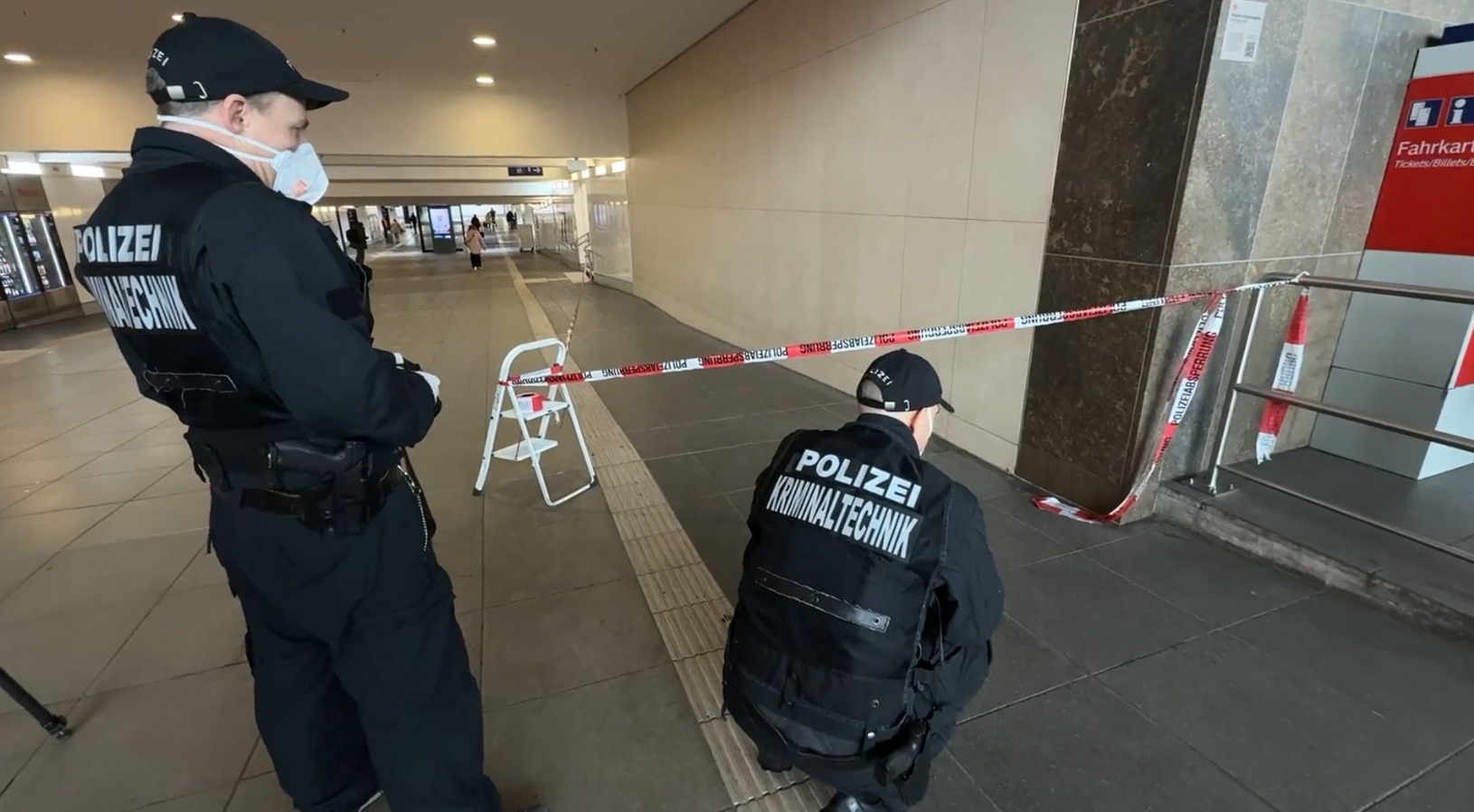
Quick-thinking bystanders — including a plain-clothes police officer — intervened and successfully overpowered the assailant, preventing further harm before law enforcement arrived. The suspect, identified by authorities as a 35-year-old man from Afghanistan, was taken into custody, while investigators began piecing together motive and context amid broader discussions in Germany about safety, public security and migration issues.
Detailed Article Rewrite (in English)
On Monday morning, the calm atmosphere inside Würzburg Central Station was shattered when a man suddenly targeted a group of Jehovah’s Witnesses with a knife. According to the police, the attacker approached the location in the station’s main hall where members of the religious community were standing at a small stand set up to speak with commuters and passers-by.
Eyewitnesses reported that the suspect made sudden stabbing motions toward one of the men — a 68-year-old — and then physically assaulted two others, aged 55 and 51, in what quickly became a violent confrontation. In the moments that followed, the three victims were knocked off balance and sustained light injuries as the scene erupted into confusion. Fortunately, none of them suffered deep cuts or stab wounds, and emergency responders later confirmed that their injuries were minor.
Police described the episode as a suspected attempted murder and swiftly moved to neutralize the threat. Aided by courageous bystanders, among whom was a police officer not in uniform, the attacker was subdued during the struggle. Once held down, he was taken into custody by arriving officers from the Bavarian police force.
Investigators have since begun an inquiry into the suspect’s background and possible motivations. At the scene, officers conducted a search of his belongings and also served a warrant to search his residence. Authorities are reviewing surveillance camera footage from within the train station and nearby streets to better understand how the confrontation unfolded and what may have led to it.
Local police emphasized that while this incident is alarming, there is currently no broader threat to public safety connected to it. The station reopened quickly after police secured the area, and rail services resumed with minimal disruption.
This event inevitably evokes memories of earlier knife attacks in Germany, including a 2021 stabbing incident in Würzburg that tragically resulted in multiple deaths. Such violent episodes have fueled national debates on public security and immigration policy, and in recent years Germany has introduced controls and measures aimed at addressing illegal immigration and reducing violent crime.
In-Depth Conclusion: Implications and the Broader Context
The knife attack at Würzburg Central Station stands as a stark reminder of how swiftly ordinary daily life can be marred by violence — even in places like train stations where community engagement and peaceful interactions are expected. While the victims were fortunate to escape with relatively minor injuries, the incident underscores ongoing concerns in Germany and across Europe about public safety, the risk of lone-actor violence, and the challenges facing law enforcement in preventing such attacks. Beyond the immediate physical harm, events like this stir anxiety among commuters, families, and religious communities, highlighting the vital role of quick intervention by civilian heroes and first responders. They also prompt deeper reflection on how societies balance open, multicultural public spaces with the need for vigilance and effective systems that identify individuals at risk of committing violent acts. As investigations continue into the attacker’s motives and background, authorities are likely to weigh the findings carefully in both legal and social policy discussions. Amid wider debates in Germany about immigration and security, this incident adds to the urgent conversation about how best to nurture safe, inclusive public environments without eroding civil liberties — a challenge shared by many modern democracies.